Caltrain riders are happy, with many new riders and greater diversity
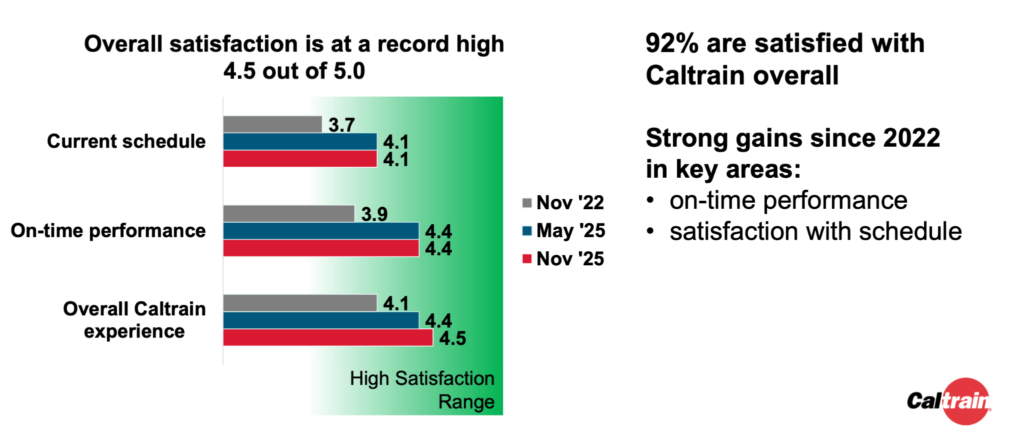
Caltrain’s most recent ridership survey shows customer satisfaction at an all time high, with strong increases in satisfaction with the schedule and on-time performance since rolling out electric service in September of 2024.

The service has attracted many new riders, with about a third of riders starting within the last year, and two-thirds starting since the pandemic, within the last 4 years. Most riders use Caltrain 2-3 times per week, in line with the post-pandemic pattern where frequent riders use transit less often than the pre-pandemic pattern of daily commuting.

Caltrain diversifies ridership
Caltrain’s most recent ridership survey shows that the service has diversified its ridership since adopting an equity policy in 2020.
The most recent ridership survey shows that 37% of riders are low income by the scale in the counties it serves. This has increased from 27% back in 2020 when Caltrain adopted its equity policy; at that time 41% of corridor commuters were low income.*
Caltrain has been pursuing a set of strategies to help diversify its ridership. These strategies include affordable fares participating in the Clipper START means-based discount program, offering free transit passes through organizations serving low income people, and participating in the regional program offering free and reduced price transfers.
The strategies also include providing more service during times outside of the white collar commute peak periods, and running a more regular service pattern that is easier for local bus service to connect to.

Station access – opportunities to improve connections
Station access is similar to the previous survey with walking the most common way of getting to the station, and only about a third driving or being dropped off in a car or ridehail service.
The agency is highlighting the need to improve transit connectivity to improve rider experience. This was called out in the 2019/2020 equity study and policy as an opportunity to diversify ridership. There are new increased opportunities to improve connections thanks to the recent rollout of free and reduced price transfers, relatively new regional initiatives for agencies to work together to improve transfers. There are opportunities to be even more proactive with efforts to make local transit faster, more reliable, and better connected.

* in the current survey Caltrain is defining low income as the three tiers of “low, very low and extremely low income”; in the 2020 survey Caltrain defined low income as the bottom two tiers, but our comparison is using the bottom three tiers for an apples to apples comparison.